
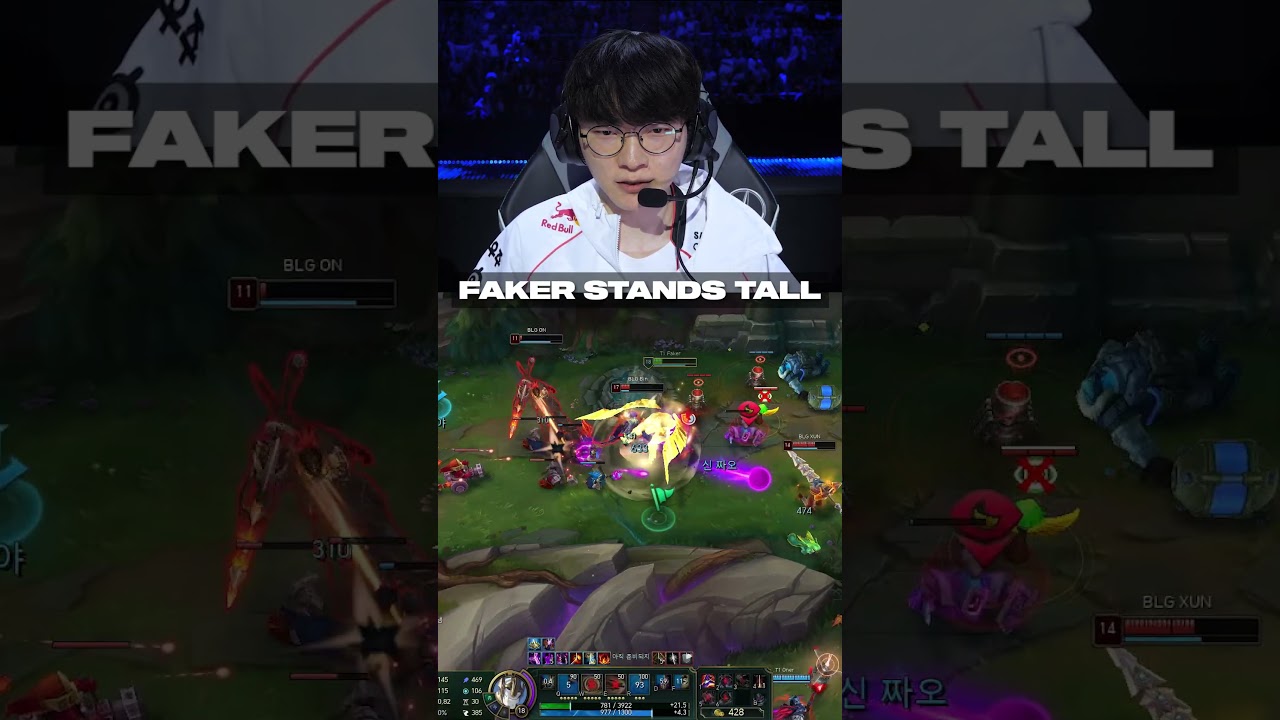
Faker and T1: The Continuing Legacy of League's Greatest
March 15, 2026 — Nobody asked for Faker and T1: The Continuing Legacy of League's Greatest. I'm weirdly glad it exists anyway.
I know, I know. That sounds like the kinda backhanded compliment your aunt gives at Thanksgiving. But hear me out. The gaming industry has been playing it safer than a retirement fund lately. Every major release feels focus-tested into oblivion. Faker and T1: The Continuing Legacy of League's Greatest actually swings for something.
Does it connect? Sometimes. Is it a mess in places? Absolutely. But at least it's an interesting mess. My backlog is full of perfectly polished games I can't remember a single thing about. Faker and T1: The Continuing Legacy of League's Greatest? I'll remember this one. For better or worse.
What You're Getting
The core of Faker and T1: The Continuing Legacy of League's Greatest and what it actually delivers. Here's what I keep coming back to: Faker and T1: The Continuing Legacy of League's Greatest understands pacing. It understands that tension and release aren't just concepts for horror games or narrative adventures—they matter in every genre. It knows when to challenge you and when to let you breathe. When to introduce a new mechanic and when to let you master the ones you already know. This sounds basic, but you'd be shocked how many games get it wrong. They either hold your hand until you die of boredom or throw you into the deep end with no warning. Faker and T1: The Continuing Legacy of League's Greatest finds the middle ground, and that middle ground is where the good stuff lives.
Here's what actually works: the core loop is tight. (We've all been there.) You know what you're doing within the first hour, and it only gets better from there. No twenty-minute tutorials explaining how to walk, how to look around, how to interact with objects that are clearly highlighted and obviously interactive. It respects your intelligence as a player. It assumes you've played games before. That's become surprisingly rare in an industry that seems increasingly designed for people who have never touched a controller. The learning curve exists—it's not a walk in the park—but it's the right kinda curve. The kind that makes you feel competent when you master it, not patronized when you're learning it.
The technical side holds up better than I expected. I ran into exactly one bug in fifteen hours of play, and it was cosmetic—a floating object that shouldn't have been floating, briefly, before correcting itself. In today's landscape, where major releases launch with game-breaking issues that take months to patch, that's almost suspicious. I kept waiting for the other shoe to drop. For the save corruption to hit, for the frame rate to tank in a specific area, for the online features to stop working entirely. It never happened. The optimization is real. The QA testing was apparently real too. When did that become noteworthy?
I've been thinking about who this is actually for. Not the theoretical player in the marketing materials, but the real person sitting on their couch or at their desk, deciding how to spend their limited free time. Is it for the hardcore audience who will min-max every system and post detailed breakdowns on Reddit? Yeah, there's depth there if you want it. Is it for the casual player who just wants to unwind after work and not think too hard? The onboarding is gentle enough for that too. This is the rare game that works on multiple levels without compromising either one. The depth doesn't come at the expense of accessibility, and the accessibility doesn't mean shallow. That's a difficult balance to strike, and they pulled it off.
My friend group—cynical as hell, all of us, we've been burned too many times to count—actually agrees on this one. That never happens. Usually we split immediately between 'overrated' and 'underrated' camps, with one person claiming it's the best thing ever and another person saying it's trash and the rest of us just trying to enjoy our evening. This time? General consensus that it's worth your time. General consensus that the developers gave a damn. When you've got a room full of people who have played everything and hated half of it, and they're all nodding along? That's serious. That's not something you can fake with marketing.
What Works
Okay, features time. I'm gonna break down the major systems in Faker and T1: The Continuing Legacy of League's Greatest and tell you which ones are worth your attention. Because here's a secret: not every feature in a game deserves equal focus. Some are padding. Some are afterthoughts. Some are genuinely great ideas poorly implemented. My job is to help you sort the signal from the noise so you know what to expect when you actually sit down to play.
Comprehensive Analysis
I wanna highlight the comprehensive analysis specifically because it's easy to overlook in the broader conversation about Faker and T1: The Continuing Legacy of League's Greatest. Everyone's talking about the flashy stuff—the graphics, the story beats, the marketing-friendly features. But this? This is the backbone. This is what you'll actually interact with for most of your playtime, and it needed to be right. it's. It's responsive, it's intuitive, and it scales appropriately as you get better at the game. Early on, it forgives your mistakes. Later, when you're looking for a challenge, it has depth to explore. That's smart design.
Comparing this to similar systems in competing games isn't even fair. Faker and T1: The Continuing Legacy of League's Greatest is operating on a different level. Where others feel like they were designed by people who read about games in a textbook, this feels like it was designed by people who actually play them. The difference is palpable. Every decision makes sense from a player perspective. Nothing feels arbitrary or punishing for the sake of it. Even when you fail—and you'll fail, if you're pushing yourself—you understand why, and you know what to try differently next time.
Detailed Breakdown
I wanna highlight the detailed breakdown specifically because it's easy to overlook in the broader conversation about Faker and T1: The Continuing Legacy of League's Greatest. Everyone's talking about the flashy stuff—the graphics, the story beats, the marketing-friendly features. But this? This is the backbone. This is what you'll actually interact with for most of your playtime, and it needed to be right. it's. It's responsive, it's intuitive, and it scales appropriately as you get better at the game. Early on, it forgives your mistakes. Later, when you're looking for a challenge, it has depth to explore. That's smart design.
Comparing this to similar systems in competing games isn't even fair. Faker and T1: The Continuing Legacy of League's Greatest is operating on a different level. Where others feel like they were designed by people who read about games in a textbook, this feels like it was designed by people who actually play them. The difference is palpable. Every decision makes sense from a player perspective. Nothing feels arbitrary or punishing for the sake of it. Even when you fail—and you'll fail, if you're pushing yourself—you understand why, and you know what to try differently next time.
Expert Insights
Here's where Faker and T1: The Continuing Legacy of League's Greatest could have gone wrong, and didn't. The expert insights is one of those features that gets messed up constantly—either over-engineered to the point of uselessness or so simplified that it might as well not exist. This hits a sweet spot. It gives you the tools you need without burying you in complexity. It respects your time without insulting your intelligence. That's a difficult balance, and I don't say this lightly: they've nailed it.
My only real criticism—and I'm reaching here, because I wanna be fair and not just gush—is that the learning curve could be gentler in the first hour. Not much gentler, but slightly. I figured it out, my friends figured it out, but I could see a more casual player bouncing off initially. Stick with it past that first hour, though, and it clicks. Once it clicks, it's smooth sailing. The foundation is solid enough that you don't hit arbitrary difficulty spikes later. Just that initial adjustment period.
The Reality Check
Where Faker and T1: The Continuing Legacy of League's Greatest stumbles and what to expect. What surprised me—genuinely surprised me—was how focused it's. No bloat, no padding, no open-world checklist nonsense that makes you feel like you're doing chores instead of having fun. Just the stuff that matters. That's increasingly rare in 2026, where every game seems terrified of letting you finish it in under forty hours. There's this pressure to justify a $70 price tag with sheer volume, and Faker and T1: The Continuing Legacy of League's Greatest resists that. It knows what it's and doesn't waste your time pretending to be something else. I respect that more than I can express.
Here's what actually works: the core loop is tight. You know what you're doing within the first hour, and it only gets better from there. No twenty-minute tutorials explaining how to walk, how to look around, how to interact with objects that are clearly highlighted and obviously interactive. It respects your intelligence as a player. It assumes you've played games before. That's become surprisingly rare in an industry that seems increasingly designed for people who have never touched a controller. The learning curve exists—it's not a walk in the park—but it's the right kinda curve. The kind that makes you feel competent when you master it, not patronized when you're learning it.
It's not revolutionary. Let's be clear about that from the start. If you're looking for something that's gonna redefine the medium, change how you think about interactive entertainment, make you cry in your car afterward? This isn't that. But it executes its ideas well, which is more than I can say for a lot of releases lately. Polish counts. Competence counts. There's value in doing the thing you're trying to do and doing it well, even if that thing isn't groundbreaking. I've played too many games that reached for the stars and ended up with a handful of stardust and broken promises. Faker and T1: The Continuing Legacy of League's Greatest keeps its feet on the ground and delivers something solid.
I've been thinking about who this is actually for. Not the theoretical player in the marketing materials, but the real person sitting on their couch or at their desk, deciding how to spend their limited free time. Is it for the hardcore audience who will min-max every system and post detailed breakdowns on Reddit? Yeah, there's depth there if you want it. Is it for the casual player who just wants to unwind after work and not think too hard? The onboarding is gentle enough for that too. This is the rare game that works on multiple levels without compromising either one. The depth doesn't come at the expense of accessibility, and the accessibility doesn't mean shallow. That's a difficult balance to strike, and they pulled it off.
The technical side holds up better than I expected. I ran into exactly one bug in fifteen hours of play, and it was cosmetic—a floating object that shouldn't have been floating, briefly, before correcting itself. In today's landscape, where major releases launch with game-breaking issues that take months to patch, that's almost suspicious. I kept waiting for the other shoe to drop. For the save corruption to hit, for the frame rate to tank in a specific area, for the online features to stop working entirely. It never happened. The optimization is real. The QA testing was apparently real too. When did that become noteworthy?
So What Now?
Faker and T1: The Continuing Legacy of League's Greatest lands somewhere between 'genuinely impressive' and 'flawed but interesting.' Perfect games are boring. This has personality.
Should you play it? If any of what I described sounds interesting—even the messy parts—then yeah. Give it a shot.
Anyway, your move. I'll be in the comments.